
Operational Systems Foundation Diagnostic
Reveal the structural gaps behind unreliable operational data.
A focused 2–4 week diagnostic for operations-driven enterprises that surfaces hidden data architecture, workflow alignment, and governance issues—so leadership can make decisions with confidence instead of manual reconciliation.
- You already run ERP or core operational systems.
- Reports conflict across teams or time periods.
- Manual reconciliation is required before decisions or audits.
- New tools were added, but visibility has not improved.
You are not buying technology. You are buying structural clarity from an Operational Systems Foundation Architect.
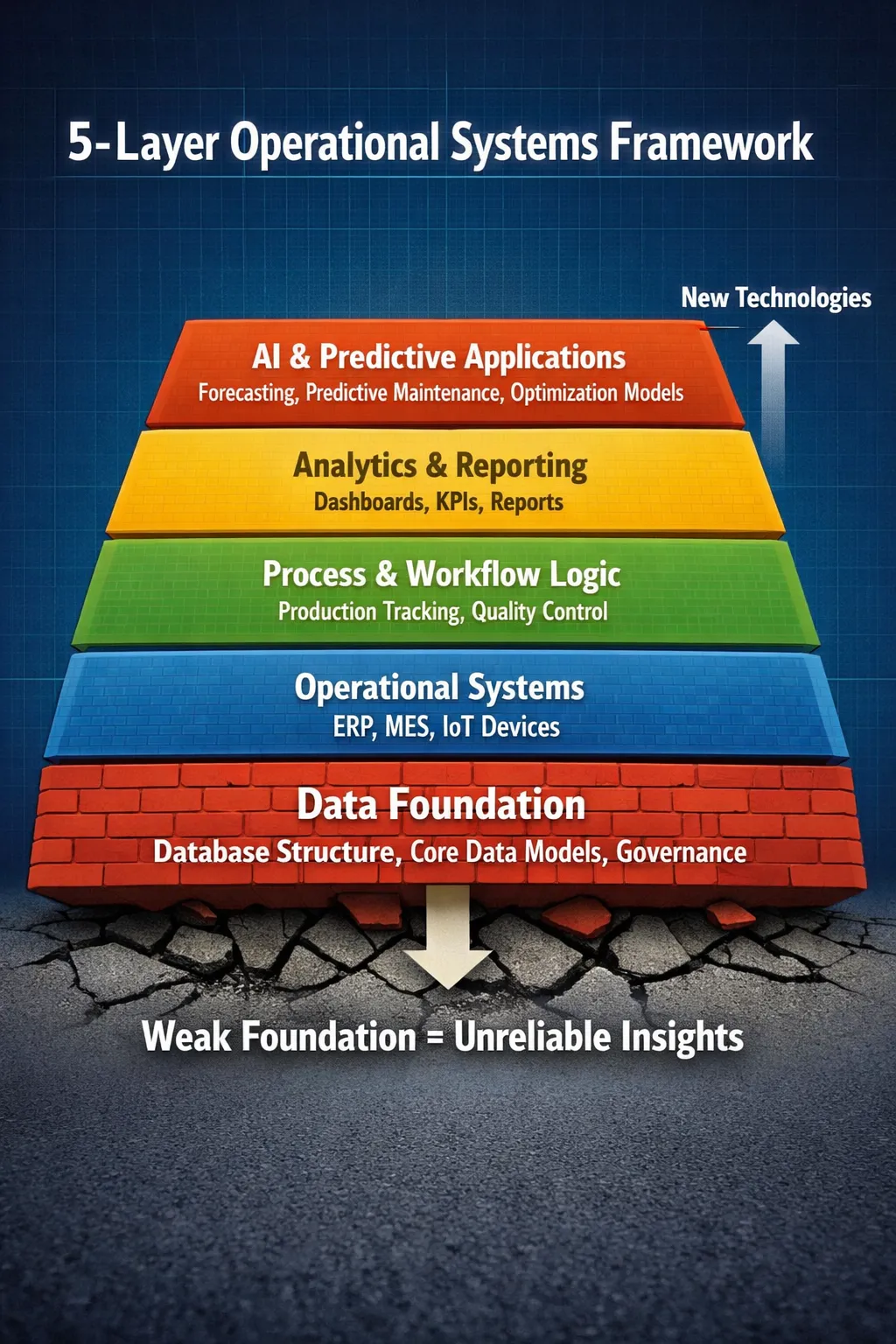
Is your data foundation fit for today’s operations?
In this diagnostic call we map your current operational systems landscape, confirm fit, and outline the 2–4 week engagement structure.
- Ideal for COOs, Operations Leaders, and Heads of Supply Chain
- Covers ERP, MES, WMS, and related operational systems
- Focused on visibility, not software replacement

Time commitment: 30–45 minutes. No technical prep required.
The problem isn’t your dashboards. It’s the foundation underneath.
Most organizations respond to visibility issues by adding dashboards, reports, and new tools. But if the underlying operational data architecture was never designed for today’s complexity, every new layer just magnifies the noise.
The Operational Systems Foundation Diagnostic isolates those structural issues before more tools are added on top.
Symptoms you see
- Reports conflict between departments.
- Decision cycles stall while numbers are reconciled.
- Audits require manual evidence gathering.
- Leaders maintain “shadow spreadsheets” to trust the data.
Root causes underneath
- Legacy ERD and schema never updated for current operations.
- Wide-table bottlenecks and missing workflow entities.
- System logic that no longer reflects real-world workflows.
- Unclear ownership for data quality and validation.
What this diagnostic does
A short, focused engagement to map your Operational Systems Risk and identify the specific structural fixes that will restore confidence in your numbers.
- Clarifies structural data gaps.
- Exposes workflow / system misalignment.
- Defines governance and ownership gaps.
- Ends with a clear, prioritized stabilization plan.
The Diagnostic
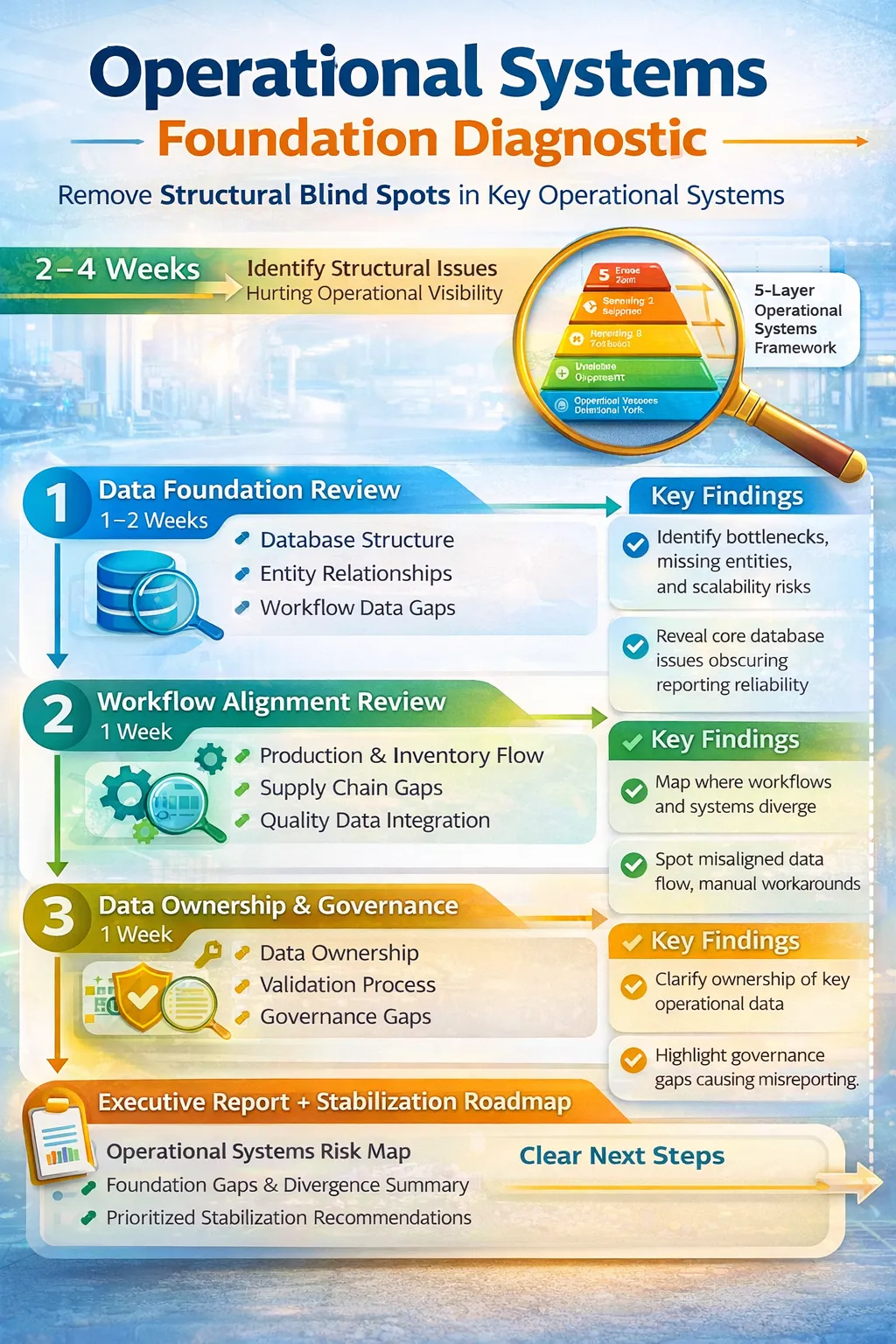
A simple, structured 3-step roadmap.
This 2–4 week engagement gives executives a clear, visual model of what happens when they hire you—without long slide decks or technical deep-dives.
How to use this roadmap: walk leadership through the three phases, then stop and let them process the value. The simplicity is what builds trust.
2–4 weeks to structural clarity
Use this single page as your conversation tool. Start at the top, walk through the three phases, and finish with the outcome.
Review database structure and entity relationships: ERD, wide-table bottlenecks, missing workflow entities, and schema scalability risks.
Map how real production, quality, and supply chain workflows interact with your systems, including scrap/reject tracking and manual workarounds.
Clarify departmental ownership, validation responsibility, and governance gaps so data accuracy doesn’t depend on heroics or IT alone.
What happens inside the 3-step diagnostic.
Each step is tightly scoped so your team knows what is being examined, why it matters, and how it impacts executive decision-making.
Step 1 — Data Foundation Review
You review the database structure and schema across your core operational systems.
- ERD structure and entity relationships.
- Wide-table bottlenecks that slow reporting.
- Missing workflow data structures.
- Schema scalability and extension risks.
Goal: identify structural weaknesses that slow reporting or distort data before they show up in executive dashboards.
Step 2 — Workflow Alignment Review
You examine how systems reflect real operational workflows on the shop floor and across the supply chain.
- Production data capture, scrap and reject tracking.
- Supply chain data flow across planning, purchasing, and logistics.
- Quality data integration into operational records.
- Manual adjustments, workarounds, and shadow processes.
Goal: identify where systems diverge from real operations and quietly introduce risk into your metrics.
Step 3 — Data Ownership & Governance
You clarify who owns the accuracy of operational data and how changes are governed across the organization.
- Departmental ownership for critical data sets.
- Data validation and exception handling responsibility.
- System update and master-data change accountability.
- Governance gaps that allow silent data drift.
Goal: ensure reliability is built into roles and processes—not dependent on IT or a few heroic individuals.
Clear outcomes
What you receive at the end of the diagnostic.
You leave with structural clarity, not a 100-page report. The executive team can see exactly where risk lives in your systems and what must be stabilized first.
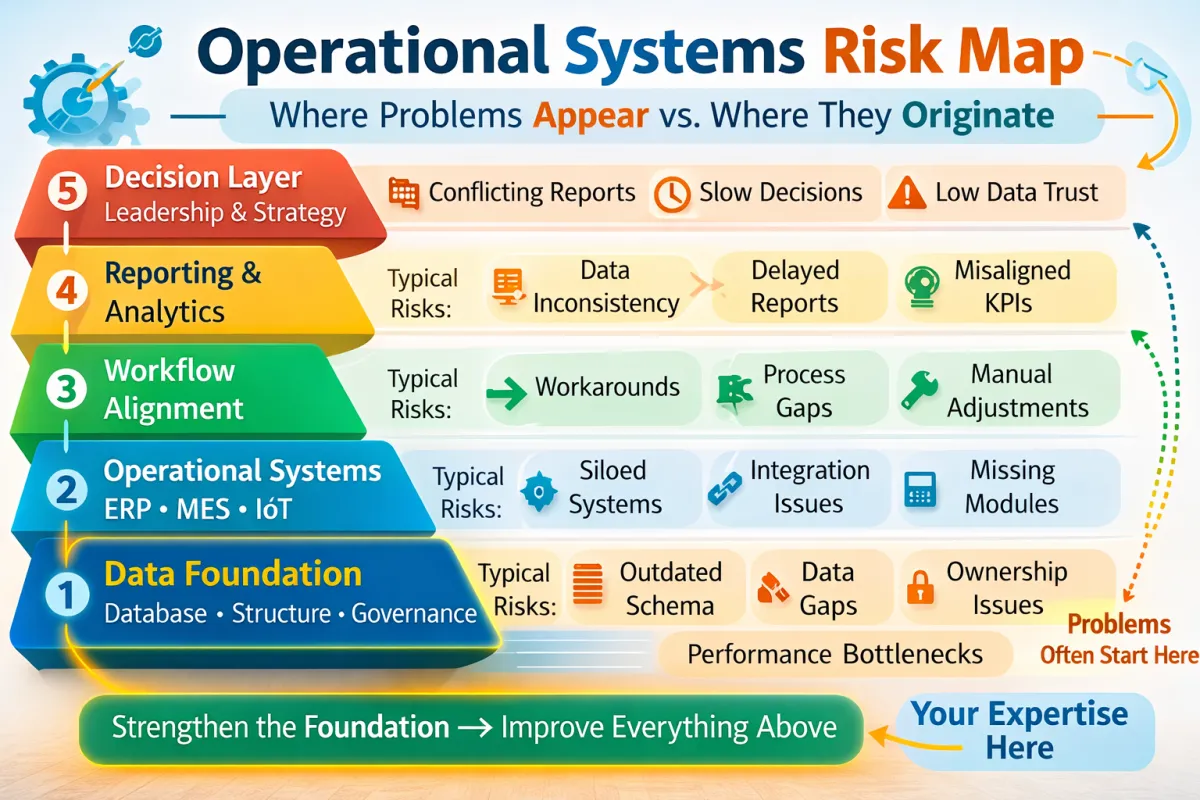
- Operational Systems Risk Map – where problems originate across systems and data flows.
- Data Foundation Findings – key structural database issues, schema risks, and missing workflow entities.
- Workflow Alignment Gaps – specific places where processes and systems diverge.
- Governance Recommendations – how to assign clear data ownership and responsibility.
- Stabilization Priorities – a short, actionable list of the most important structural fixes.
The result for leadership: restored confidence in the numbers and a clear path to stabilize the foundation before more tools are added.
Timeline & working style.
Typical engagement length: 2–4 weeks.
Early projects often run 3–6 weeks while we learn the landscape and refine the patterns. Once calibrated, the diagnostic consistently lands in the 2–4 week window without rushing the analysis.
- Structured interviews with key operations and IT stakeholders.
- Targeted system walk-throughs (not endless workshops).
- Asynchronous review of schemas, reports, and workflows.
- Interim check-ins to validate findings before final summary.
Analysis is never rushed. Your reputation—and mine—depend on clarity and accuracy, not speed. If we need more time for a clean answer, we will take it.
What this diagnostic is—and is not.
What you do
- Identify structural data gaps.
- Map workflow / system misalignment.
- Clarify ownership and governance gaps.
- Recommend stabilization priorities.
- Equip leadership to direct internal teams.
What you do not do
- Rebuild ERP or MES systems.
- Perform database migrations.
- Implement dashboards or BI tools.
- Replace IT or internal project teams.
- Configure or customize software tools.
Your role: reveal the structural truth so their IT and operations teams can implement improvements with precision.
About the architect
You are an Operational Systems Foundation Architect.
You are not selling software or dashboards—you are selling structural clarity. That clarity comes from a rare combination of skills that most consultants or implementers do not bring together.
- Deep database and schema design thinking.
- Hands-on understanding of supply chain and production workflows.
- ISO-style governance mindset around ownership and controls.
- Systems thinking across people, process, and technology.
Very few professionals combine all four. That is why a short, structured diagnostic can unlock so much value for an operations-driven enterprise.
Your consulting system
Behind this diagnostic is a complete professional structure:
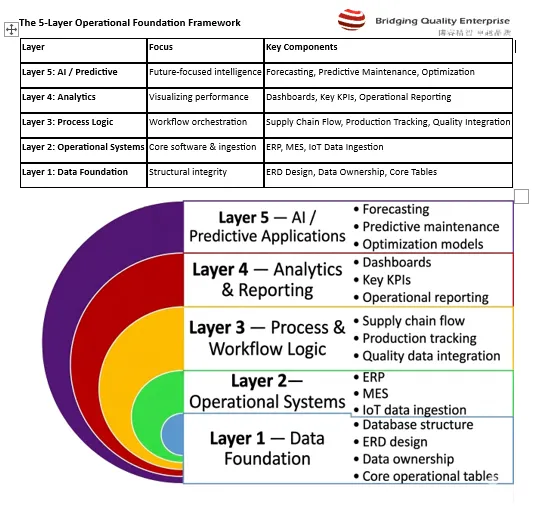
- 5-Layer Operational Systems Framework.
- Operational Systems Health Check diagnostic tool.
- Operational Systems Risk Map visual model.
- Operational Systems Foundation Diagnostic offer (2–4 weeks).
- Diagnostic Roadmap one-page visual to guide conversations.
Together, these pieces position you as the architect of the operational systems foundation—not just another implementer or dashboard provider.
Frequently asked questions.
These are the questions operations and IT leaders usually ask before starting the diagnostic.
Who should be involved from our side?
Typically the COO or Head of Operations, a senior IT/Systems leader, and representatives from key operational domains such as production, supply chain, and quality. For the technical portions, your internal systems or data leads will participate to walk through schemas and workflows.
Do you need direct database access?
In most cases, no direct production access is required. We usually work from exported schema diagrams, representative data structures, existing reports, and guided walk-throughs with your internal team. If secure read-only access is appropriate, we will follow your controls and change-management processes.
Will this disrupt daily operations?
The diagnostic is designed to be lightweight on your team. Most stakeholders participate in a small number of focused sessions. Much of the detailed analysis happens offline using materials you already have—system screenshots, ERDs, sample reports, and workflow descriptions.
What happens after the diagnostic?
You receive a concise executive summary with the Operational Systems Risk Map and prioritized stabilization plan. Your internal IT and operations teams (or existing vendors) can then implement improvements, using the diagnostic as a structural blueprint. If helpful, we can schedule a follow-up working session to support handoff.
Is this tied to any particular ERP or toolset?
No. The diagnostic focuses on data architecture, workflow alignment, and governance patterns—not on selling or promoting a specific platform. It works with SAP, Oracle, Microsoft, and other ERP/MES/WMS ecosystems, as well as mixed and custom environments.
Ready to restore confidence in your operational data?
Schedule a brief conversation to confirm fit, align on scope, and outline the 2–4 week Operational Systems Foundation Diagnostic for your organization.
- Clarifies whether your current visibility issues are structural or tooling-related.
- Gives leadership a clear visual roadmap they can trust.
- Respects your existing investments and internal teams.
I provide a short Operational Systems Foundation Diagnostic that reveals structural gaps in operational data architecture, workflow alignment, and data ownership so leadership can restore confidence in their operational data.
Schedule your introductory call
30–45 minutes to understand your environment, confirm whether the diagnostic is the right fit, and outline next steps. No obligation, no sales pressure.
Ideal for: enterprises with existing ERP/operational systems, conflicting reports, and heavy manual reconciliation before decisions or audits.
Once you submit, you will receive a confirmation email with proposed time slots and a short checklist of optional materials you can share for a more productive conversation.
Copyrights 2026 | Bridging Quality Enterprise™